Sewer Line Repair in Greenpoint, Brooklyn
A main sewer line failure is one of the most disruptive emergencies a property owner can experience. When wastewater from toilets, sinks, and laundry backs up into basement utility spaces, the threat to personal property and building sanitation is immediate. In Greenpoint's historic streetscapes, mature trees, high groundwater near Newtown Creek, and aging clay and cast-iron infrastructure create significant structural challenges for underground pipes. Our specialized sewer line repair Greenpoint Brooklyn service delivers diagnostic camera clarity and lasting structural repairs.
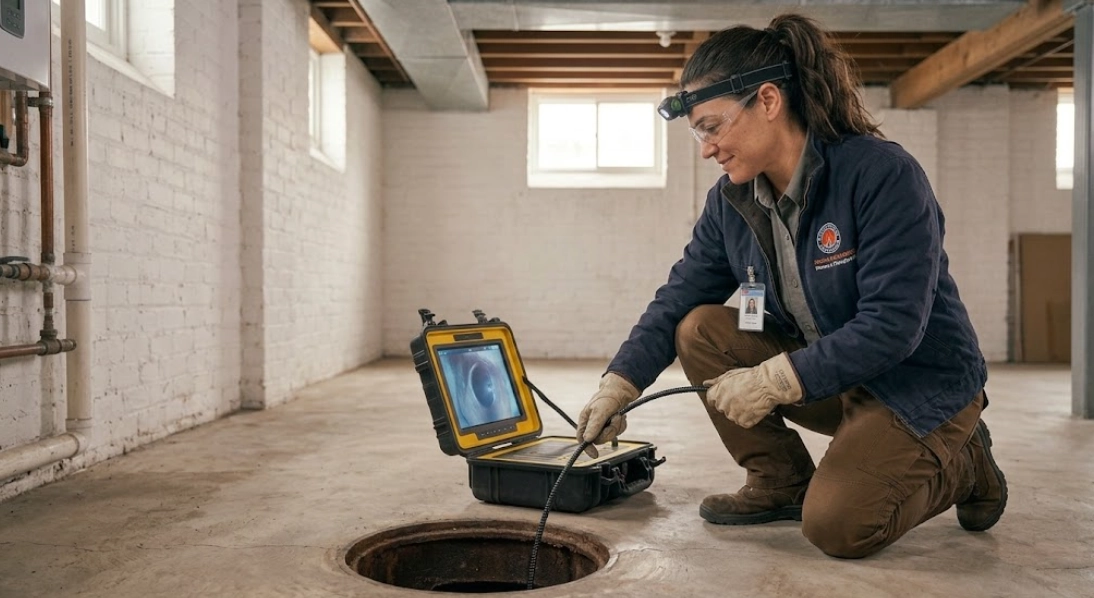
High-Definition Sewer Camera Inspections
Before recommending any invasive excavation or major repair work, establishing the exact condition of the underground pipe is essential. Guesswork has no place in underground plumbing engineering. We deploy state-of-the-art sewer camera inspection Greenpoint Brooklyn equipment to inspect your lateral line from the inside.
Our fiber-optic video cameras are guided through your building's main house trap or cleanout. Self-leveling, high-resolution color optics illuminate pipe walls in real time, revealing root intrusions, cracked bells, offset joints from soil shifting, foreign object obstructions, and pipe bellies (sags holding standing water). The camera head includes a built-in 512 Hz radio transmitter (sonde). Using a digital wand receiver above ground, our technicians mark the precise location and depth of the damage on concrete or soil, eliminating broad exploratory trenching.
Emergency Sewer Backup Repair Solutions
When wastewater surfaces unexpectedly in your basement, prompt sewer backup repair Greenpoint Brooklyn is essential. In properties where mechanical snaking provides only temporary relief before pipes back up again days or weeks later, an underlying structural fault is almost certainly present.
In historic Greenpoint properties, sewer laterals were frequently constructed of vitrified clay pipe assembled in three-foot sections. Over decades, mortar joints crumble, allowing tree roots seeking moisture to penetrate the pipe. As root masses expand inside the pipe, they trap paper and solids until flow stops completely. We mechanically clear heavy root blockages, assess the residual wall strength, and determine whether localized point repair or complete lateral replacement is needed.
Localized Point Repairs vs. Full Line Replacement
We prioritize practical, cost-effective engineering. When a camera inspection demonstrates that the majority of your sewer run remains structurally sound and aligned, performing an isolated excavation and spot repair makes tremendous economic sense.
We excavate directly over the marked fault, remove the fractured section of clay or cast iron, and install heavy-gauge extra-heavy cast iron or SDR-35 PVC connected with heavy-duty stainless steel shielded transition couplings. If, however, the pipe has suffered widespread channel rot, complete structural collapse, or reverse grading throughout its run, we manage full line replacements with proper trench shoring, gravel bedding, and asphalt restoration.
Understanding NYC DEP Private Sewer Responsibility
Property owners frequently wonder where municipal responsibility begins. Under New York City Department of Environmental Protection (DEP) regulations, property owners are generally responsible for maintaining and repairing the entire house sewer line from their building footprint all the way to the connection with the city sewer main in the public street.
Because city street excavations require extensive street opening permits from the NYC Department of Transportation (DOT), licensed Master Plumber filings, and DEP street inspections, identifying the exact problem boundary before excavation begins is paramount. Our team works closely with property owners to coordinate compliant documentation and prevent unnecessary street openings. When indoor plumbing systems are affected, we also coordinate with our drain cleaning, leak detection, and boiler repair teams to ensure complete utility integrity.
Frequently Asked Questions About Sewer Line Repair
The primary indicators include recurring raw sewage backups into basement floor drains, simultaneous gurgling or slow drainage across multiple fixtures on the ground floor, persistent sewer gas odors in the basement or yard, and unexplained soggy depressions in the soil along the sewer line path.
Under NYC Department of Environmental Protection (DEP) regulations, private property owners are generally responsible for maintaining and repairing the house sewer line from the building exterior all the way to its connection with the municipal sewer main in the street, including the tap or spur, subject to specific property and utility easements.
A sewer camera transmits live high-definition color footage from inside the pipe, featuring a radio sonde beacon that pinpoints the camera head's exact location, depth, and distance from the cleanout. This reveals whether the issue is simple root intrusion, a localized collapsed section, or full pipe failure, preventing random trenching.
Yes. If the sewer camera confirms that the rest of the pipe has good structural integrity with adequate slope, and the damage is isolated to a single offset joint, cracked section, or localized root penetration, a targeted excavation and point repair can restore functionality at a fraction of whole-line replacement cost.