Steam Heat & Radiator Repair in Greenpoint, Brooklyn
In historic three-story wood-frame row houses, classic pre-war brick tenements, and converted industrial buildings across Greenpoint, cast-iron radiators provide robust, comfortable winter warmth. However, when shutoff valves corrode, air vents stick, or building settling disrupts pipe alignment, heating comfort breaks down quickly. Our specialized radiator repair Greenpoint Brooklyn service resolves cold rooms, loud pipe knocking, and leaking valves to restore balanced heating across your entire building.
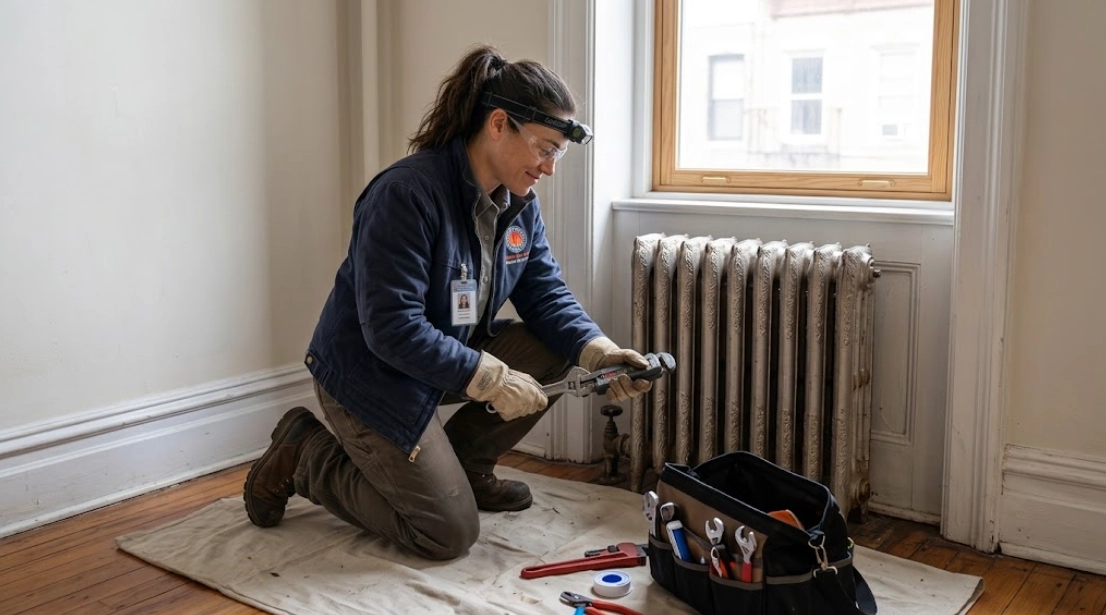
Resolving Banging Steam Pipes and Water Hammer
Few household sounds are more alarming than violent, metallic clanking echoing through floors and walls. When property owners struggle with banging steam pipes Greenpoint Brooklyn, the root cause is almost always hydraulic shock known as water hammer.
In steam heating systems, steam rushes from the boiler through supply mains at speeds between 20 and 30 miles per hour. As steam releases heat into cast-iron radiators, it condenses back into liquid water. In single-pipe systems, this condensed water must drain back down the exact same pipe that brings steam upward. If a radiator has settled backward, or if a horizontal steam run has lost its downward slope toward the boiler, condensed water pools in the line. When incoming steam collides with this water pool, it propels a slug of water forward at immense velocity, slamming against elbow fittings and radiator valves. We measure pipe pitches, install shims under radiator legs, and re-hang sagging pipe mains to ensure continuous drainage.
Precision Steam Radiator Valve Replacement
Radiator shutoff valves endure extreme temperature cycling for decades. Over time, graphite packing inside the valve bonnet dries out, causing water or steam to leak around the handle stem, ruining hardwood floors and staining downstairs ceilings.
We provide professional steam radiator valve replacement Greenpoint Brooklyn homeowners and landlords can trust. Removing old brass valves from ancient cast iron requires proper heating techniques, specialized spud wrenches, and thread cleaning to avoid cracking the radiator spud connection. When necessary, we install modern thermostatic radiator valves (TRVs) on compatible systems to give residents autonomous room-by-room temperature regulation without throttling steam flow.
Air Vent Diagnostics: Fixing Cold Radiators & Hissing
A common misconception is that a cold radiator means the central boiler is broken. In reality, steam can only enter a radiator if the air originally inside the casting can escape. Every steam radiator relies on a calibrated air vent (air valve) with an internal bi-metal strip or alcohol-filled bellows.
If an air vent becomes clogged with boiler sediment, rust, or layers of wall paint, the vent remains closed. Air is trapped, creating an invisible barrier that blocks incoming steam. Conversely, if an air vent fails open, it continuously hisses, releases excessive humidity into living areas, or spurts dirty rusty water. We test and replace defective radiator air vents and inspect large-capacity main-line vents in the basement that allow steam to travel quickly to the building's furthest heating risers.
How Radiator Symptoms Link to Central Boiler Performance
Radiator problems rarely exist in isolation; they are deeply connected to the health of your central boiler repair system. If the boiler's pressuretrol switch is calibrated too high (above 1.5 to 2 psi), high pressure prevents air vents from opening properly and wastes immense fuel. Furthermore, if oily residue on the boiler's internal water surface causes surging or priming, water surges up the main riser into radiators. In cases where the heating plant is severely damaged, our technicians can evaluate whether boiler replacement or water heater repair is appropriate.
Frequently Asked Questions About Radiator Repair
Loud metallic knocking, known as water hammer, occurs when high-velocity steam collides with pools of cooled condensate trapped inside pipes or radiators. This usually results from an unpitched radiator, a partially closed supply valve, a sagging horizontal steam pipe, or excessive boiler pressure.
A radiator that stays partially cold is usually airbound. Steam cannot enter a radiator section until trapped air escapes through the air vent. If the vent is clogged with mineral scale, corrosion, or paint, air remains trapped inside, preventing steam from warming the rest of the unit.
In a single-pipe steam system, you must never throttle the supply valve partially. The valve must be fully open or completely shut. Leaving it partly closed restricts returning condensate from draining against incoming steam, triggering immediate water hammer and valve stem leaks.
Spitting vents indicate that boiler water is surging into the steam header (often due to dirty, oily boiler water), the radiator is pitched the wrong way (trapping water inside the casting), or the internal float inside the air vent has failed and can no longer seal against moisture.